
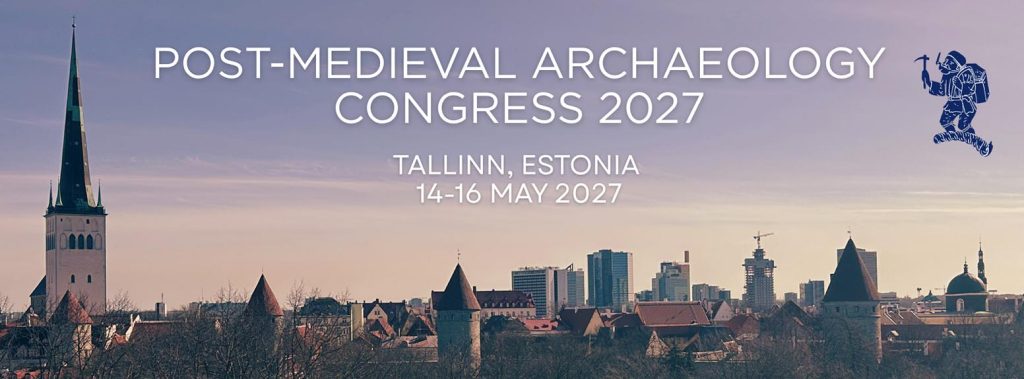
We look forward to welcoming you to Tallinn, Estonia for PMAC27, the ninth annual Post-Medieval Archaeology Congress!
PMAC27 will be hosted in Tallinn, the capital of Estonia from 14 to 16 May, 2027. The city is located on the coast of the Baltic Sea and it was the most northern member of the Hanseatic League. The port on the Gulf of Finland became an important medieval and post-medieval trade centre. Tallinn Old Town is a UNESCO World Heritage Site.
Call for Papers, Sessions, Posters and Panels
The Congress is open to all researchers to report current and recent research on any aspect of post-Medieval archaeology. There is no geographical focus, and we welcome papers from around the world. We ask contributors to offer 15-minute papers (which the organizers will arrange into themed sessions) or poster displays. You can also suggest alternative activities including discussion panels, symposia, a forum or round table.
Send your paper, poster or alternative activity proposals by 1 November 2026 to conference@spma.org.uk. Please include:
- Paper, session, poster or activity title
- An abstract of up to 150 words
- The author(s) affiliations
- The corresponding author email address.
For panels, symposia, forum or round table proposals, please also include a list of speakers.
You may self-nominate your paper or poster to a themed session. The 2027 themes are:
- Swedish Empire: the archaeology of Stormaktstiden (organizers Erki Russow and Astrid Wendel-Hansen)
- Interrogating Russkiy Mir: The Heritage of the Russian Empire (organizers Anatolijs Venovcevs, Simon Radchenko and Monika Stobiecka)
- Terror and resistance
- Dangerous cultural heritage: environmental threat from archaeological sites
- On the margins: East and West
- Cultural aspects of post-Medieval mortuary archaeology (organizers Sanna Lipkin and Harold Mytum).
You may propose your own theme(s) as well.
We will notify authors by email of the status of their submission by 1 December 2026. Please note that all papers and sessions at PMAC27 will be delivered in person. Registration will open closer to the Congress. You will be able to register via Eventbrite.
Students can apply to our Paul and Yolanda Courtney Congress Bursary Award for financial help to attend the Congress. We prioritize students, first-time attendees, low-income and BAME and minority applicants to the Award. There is no age restriction. The deadline to apply is 15 January 2027.
Programme
The preliminary programme includes a day of tours, the opening lecture and reception, followed by the Scientific Programme over two days.
14 May 2027: tours, SPMA Council meeting, opening lectures and reception at St Nicholas (Niguliste) Church.
St. Nicholas’ Church was built in the 13th-century. It was damaged during air raids in March 1944 and the interior and almost everything that had been left un-evacuated was destroyed by fire.
The building stood in ruins until 1953 but after decades of restoration, it was opened as a branch of the Art Museum of Estonia in 1984.
It has both a permanent exhibition and frequently hosts world-class travelling exhibitions as well as concerts.
The museum is home to German and Dutch late medieval altarpieces and disused church bells and known for its Silver Chamber which houses silverware that belonged to churches, guilds and the Brotherhood of Black Heads. The most well-known work in the museum is Bernt Notke’s Danse Macabre from the late 15th-century. The church tower has a glass lift that takes visitors 50 metres above ground to an enclosed sky-deck, offering a unique and accessible view of the Old Town and Tallinn Bay.
The church is wheelchair-accessible, there are guideways, a tactile floor plan and a model of the church for the visually impaired.
Our walking tours on 14 May will include:
- The Fortifications of Tallinn, led by Ragnar Nurk (archaeologist, Tallinn Urban Planning Department Heritage Protection Unit), £5.
- Patarei Fortress-Prison, led by Robert Treufeldt (architecturial historian), £15.
You will be able to reserve and pay for tour tickets on Eventbrite, when booking opens in the future. Watch this space!
15 – 16 May 2027: Scientific Programme hosted at Tallinn University main campus and Tallinn Old Town walking tour.
Saturday: 09:00 to 17:30, Sunday: 09:00 to 16:00.
Tallinn University was officially founded in 2005 and is one of the three largest institutions of higher education in Estonia. The university has almost 7,000 students and employs almost 400 lecturers and researchers.
Tallinn University has been represented in world university rankings since 2019 but its roots go back to 1919, when Tallinn Teachers’ Seminar was established. Pedagogical training is still a core strength of the university which also houses the Estonian Pedagogical Archives-Museum (A.D. 1922).
The campus is located in the heart of Tallinn. The PMAC27 programme will take place in one of the newest buildings, Astra. All floors of Astra are wheelchair accessible. The campus is well-connected with tram and bus stops located at the entrance or within a short walking distance.
The Old Town tour will start at the Tallinna Ülikool (Tallinn University) tram stop after the scientific programme, with a meet-up point in Old Town. The tour is free but places are limited and registration will be required via Eventbrite. Further details will be provided closer to the date.